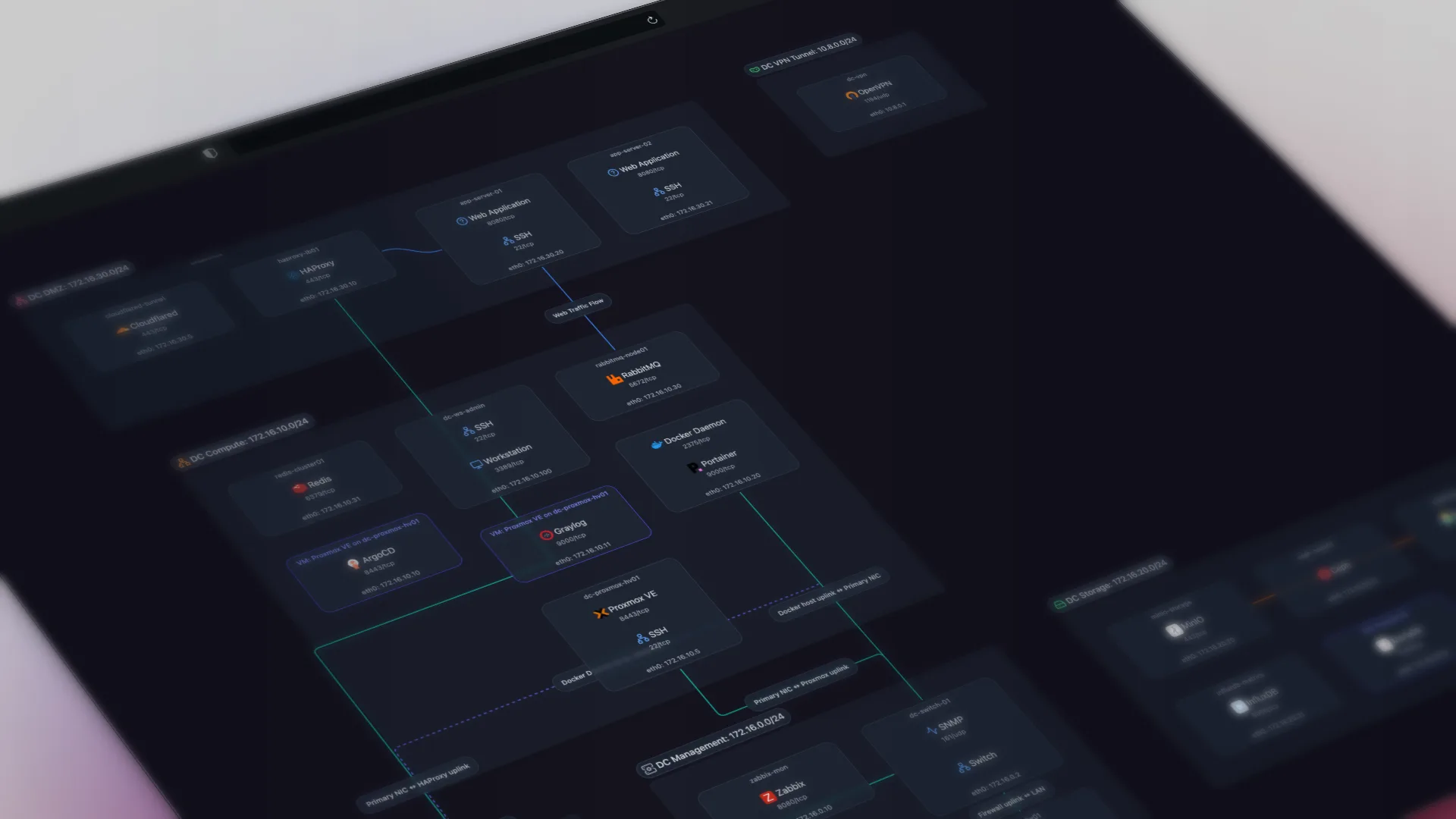
Looking for a Observium alternative? Observium is built for teams that want autodiscovering SNMP monitoring across mixed vendors and can treat mapping as a per-device view. Observium's trade-off: mapping is a device-level view, so seeing the whole network means reaching for a community generator. These are the best Observium alternatives for network discovery, topology visualization, and living documentation, starting with the one we build, Scanopy.
The best Observium alternatives
Scanopy Our pick
A dedicated network documentation tool: one scan produces four switchable views (L2 physical, L3 logical, workloads, and applications) plus per-host service detection, at flat pricing regardless of host count, with a free, self-hostable Community edition.
NetBox
NetBox is for network and automation teams building a structured source of truth to drive Ansible, Nornir, or Terraform.
Scanopy vs NetBox, head to head →phpIPAM
phpIPAM is for teams that plan and assign address space, including ranges reserved before anything is deployed.
Scanopy vs phpIPAM, head to head →OpenNMS Horizon / Meridian is for larger networks that want protocol-level topology discovery inside a full monitoring platform.
Scanopy vs OpenNMS Horizon / Meridian, head to head →Zabbix
Zabbix is for teams that want one free monitoring platform across servers, applications, and network devices.
Scanopy vs Zabbix, head to head →Auvik
Auvik is for MSPs who need monitoring, alerting, and network maps in one cloud-managed platform.
Scanopy vs Auvik, head to head →NetBrain
NetBrain is for large enterprises that need network maps integrated with automation and troubleshooting workflows.
Scanopy vs NetBrain, head to head →SolarWinds Network Topology Mapper is for enterprise teams that standardize on Microsoft tools and need Visio-native network diagram exports.
Scanopy vs SolarWinds Network Topology Mapper, head to head →Domotz
Domotz is for cost-conscious MSPs who need monitoring, remote access, and basic network maps at a published price.
Scanopy vs Domotz, head to head →ManageEngine OpManager is for mid-market IT teams that want monitoring and visualization at a lower per-device cost.
Scanopy vs ManageEngine OpManager, head to head →PRTG Network Monitor is for teams already running Paessler for monitoring who want status dashboards alongside their sensor data.
Scanopy vs PRTG Network Monitor, head to head →LibreNMS
LibreNMS is for teams with Linux skills that want free, self-hosted monitoring with basic topology visualization.
Scanopy vs LibreNMS, head to head →NetDisco
NetDisco is for network teams that want free, open-source Layer 2 topology discovery and device tracking.
Scanopy vs NetDisco, head to head →Faddom
Faddom is for enterprise IT teams mapping application dependencies for data center migrations and cloud transitions.
Scanopy vs Faddom, head to head →Observium alternatives compared
How Observium and each alternative compare on discovery, the four topology views (L2, L3, workloads, applications), service detection, pricing, and licensing.
| ToolProduct name and link to vendor site | DiscoveryProtocols used to find devices and map connections | Network ViewsWhich topology views the tool produces from discovery. L2 Physical switch ports and links L3 Subnets, VLANs, routing Workload VM/container host nesting Application Service-dependency / app grouping Yes supported Tag ? unverified Greyed not supported | ServicesNo No service awareness Basic Common port detection Yes Application-level fingerprinting | PricingStarting price or pricing model | Open SourceOSI OSI-approved open source license Source available Source code available, restricted license No Proprietary |
|---|---|---|---|---|---|
| Observium | SNMP CDP LLDP [50] | No | Free (Community); Professional subscription [51] | OSI QPL | |
| Scanopy | SNMP LLDP CDP ARP ICMP mDNS TCP/UDP | Yes260+ types | Starts at $79.99 monthly, unlimited hosts | OSI AGPL-3.0 | |
| NetBox | ICMP SNMP SSH/CLI | No | Cloud and Enterprise: contact sales [42] | OSI Apache-2.0 | |
| phpIPAM | SNMP ICMP [47] | No | Free | OSI GPL-3.0 | |
| OpenNMS | SNMP CDP LLDP ICMP [52] | Basic | Free (Horizon); Meridian subscription [55] | OSI AGPL-3.0 | |
| Zabbix | SNMP ICMP | No | Free | OSI AGPL-3.0 | |
| Auvik | SNMP CDP LLDP ARP [1] | Basic [2] | Per-device (contact sales) | No | |
| NetBrain | SNMP CDP LLDP ARP SSH/CLI | No | Enterprise (contact sales) | No | |
| SolarWinds NTM | SNMP WMI CDP LLDP ICMP [3] | No | Perpetual ~$1,570 (subscription shift unclear) [44] | No | |
| Domotz | SNMP ARP ICMP CDP LLDP mDNS NetBIOS [5] | Basic [6] | $1.50/device/mo [7] | No | |
| ManageEngine OpManager | SNMP CDP LLDP ARP [8] | No | From $95/yr (10 devices) [9] | No | |
| PRTG | SNMP WMI ICMP [13] | No | Free to 100 sensors, then $200-$1,642/mo [4] | No | |
| LibreNMS | SNMP CDP LLDP [10] | No | Free | OSI GPL-3.0 | |
| NetDisco | SNMP CDP LLDP ARP [12] | No | Free | OSI BSD | |
| Faddom | NetFlow/sFlow [23] | Basicapp dependencies [23] | Free up to 50 servers then from $19,000/yr [24] | No |
Why Scanopy is a strong Observium alternative
Observium and Scanopy both discover devices over SNMP and read CDP and LLDP neighbour data, and both are self-hosted. Observium is a monitoring platform: it polls device health and interface counters, graphs them over time, and autodiscovers by following neighbours until it has walked the reachable network. Scanopy is a documentation tool: one scan produces four views of the same network (physical L2, logical L3, workloads, and applications) plus per-host service detection, and it rescans on a schedule.
The mapping is where the two diverge. Observium's topology is a per-device view: a neighbours page, and a Map sub-tab on an interface showing one level of connections. Drawing the whole network from that data means running a community LLDP map generator against the Observium database. Scanopy renders the whole network as an interactive map, and gets it out three ways: export as an image, self-contained HTML, wiki markup, or CSV; embed the live map in a wiki or intranet via iframe; or share a read-only link that stays current as the network rescans.
Editions differ too. Observium Community is QPL-licensed and ships on a 6-monthly release cycle, with threshold monitoring and traffic accounting in the paid Professional subscription. Scanopy is free under AGPL-3.0, or flat monthly with unlimited hosts and commercially self-hostable. If you want SNMP monitoring with device-level neighbour views, Observium does that and has done for years. If you want the whole network drawn, kept current, and exportable, Scanopy is built for that, and it runs alongside monitoring rather than replacing it.
Frequently asked questions
What is the best alternative to Observium?
The right alternative depends on what you use Observium for. If you want automatic network discovery with living L2, L3, workload, and application views and per-host service detection, Scanopy is the closest dedicated alternative: flat pricing regardless of host count, plus a free, self-hostable Community edition. Observium itself remains the better choice when you specifically need teams that want autodiscovering SNMP monitoring across mixed vendors and can treat mapping as a per-device view.
Is there a free or open-source Observium alternative?
Yes. Scanopy, NetBox, phpIPAM, OpenNMS, Zabbix, LibreNMS, and NetDisco are open-source (OSI-licensed). Scanopy's Community edition is free to self-host under AGPL-3.0 and produces the full L2, L3, workload, and application views; the paid plans add cloud hosting and support at flat pricing.
Why do teams look for a Observium alternative?
One documented limitation: mapping is a device-level view, so seeing the whole network means reaching for a community generator. Scanopy produces an up-to-date visual map of what is on the network without a separate monitoring platform, which is why it is compared against Observium.
Comparing just these two? See the focused Scanopy vs Observium head-to-head. For all 13 tools side by side, see the full network diagram tools comparison.
Sources
[2] Auvik - Can Auvik discover services on my network?
[3] SolarWinds - Network Topology Mapper
[4] Paessler - PRTG Pricing
[5] Domotz - Agentless Network Discovery for MSP Client Onboarding
[6] Domotz - Device TCP/UDP Ports/Services Discovery
[7] Domotz - Pricing
[8] ManageEngine - Discover Networks
[9] ManageEngine - OpManager Editions
[10] LibreNMS - Auto-Discovery
[12] NetDisco - Documentation
[13] Paessler - PRTG System Requirements
[23] Faddom - Agentless Application Dependency Mapping
[24] Faddom - Pricing
[42] NetBox Labs - Pricing (Cloud and Enterprise contact sales)
[44] SolarWinds NTM - Pricing (TrustRadius)
[47] phpIPAM - Open source IP address management (GPL-3.0)
[50] Observium - Autodiscovery via CDP, LLDP, FDP, EDP and OSPF neighbours
[51] Observium - Subscribe: Community vs Professional editions
[52] OpenNMS - Enhanced Linkd (Enlinkd): five link-discovery methods enabled by default
[55] OpenNMS - Meridian subscription pricing
Started as a homelabber, now deep in SNMP MIBs, Layer 3 topology, and service fingerprinting - building the network documentation tool I wished existed.