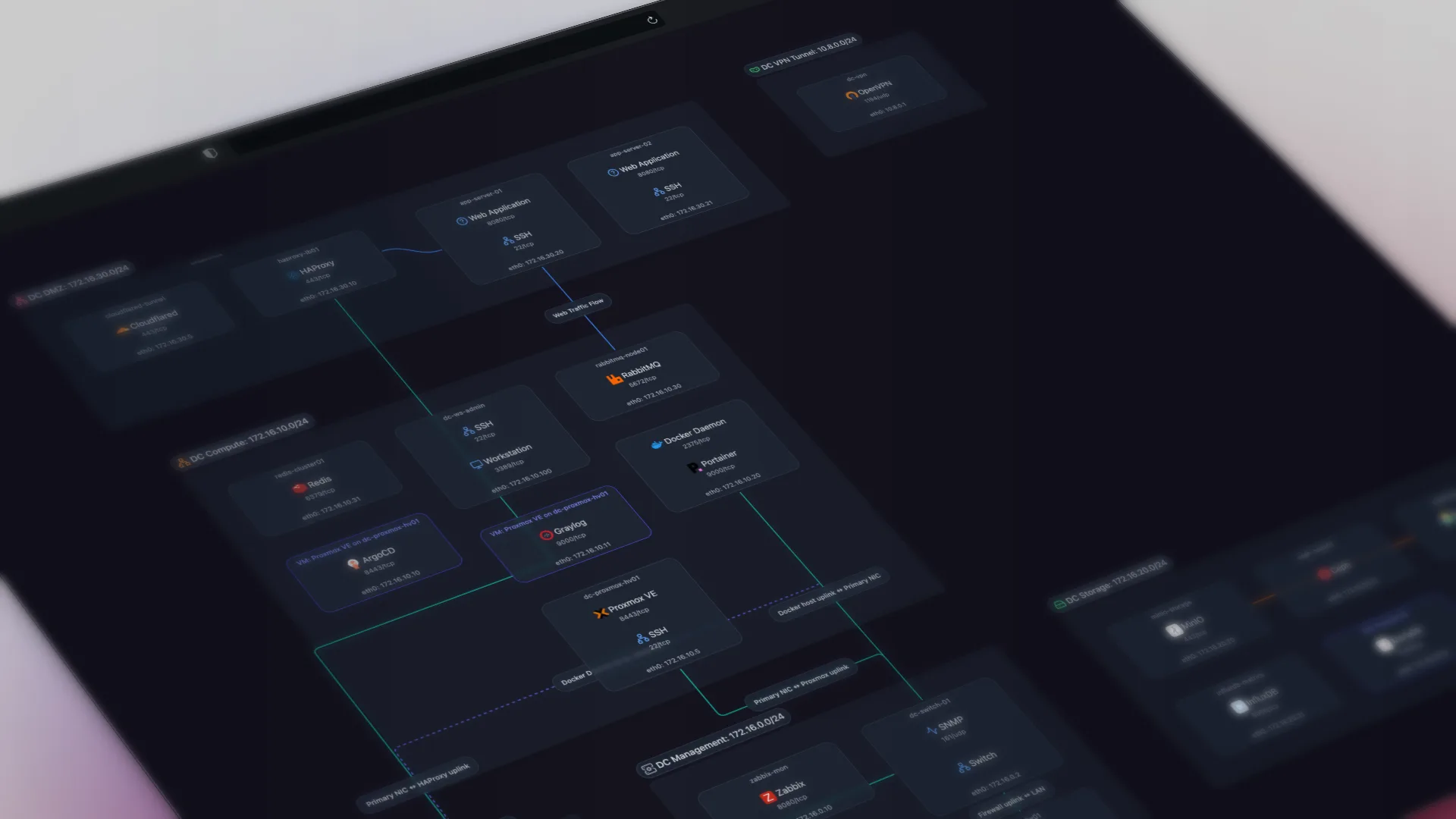
Network documentation shouldn't be a chore
Scanopy exists because keeping network documentation accurate is tedious, thankless work - and nobody actually does it. We built a tool that does it for you.
How it started
If you've spent any time on r/homelab or r/selfhosted, you've seen the posts. Someone shares a beautifully detailed network diagram - color-coded VLANs, labeled switches, the works - and the comments light up. "How did you make this?" "What tool is that?" "I need to do this for my network."
I was one of those commenters. I always wanted a proper network diagram. I just never wanted to actually make one.
The process is always the same: you open draw.io or Visio, spend a few hours dragging boxes around, feel good about yourself for a week, and then never update it again. Your network changes, the diagram doesn't, and six months later it's fiction.
So I took the technical overkill route and built a tool that scans your network and generates the diagram automatically. That became Scanopy.
How we think about this
Documentation should be derived from infrastructure, not maintained alongside it.
Think of it like OpenAPI specs annotated inline in the codebase - the documentation isn't fully automatic, but it's heavily derived from the technical system it describes. That's the only way it stays accurate. Scanopy works the same way: it pulls directly from your actual network to generate documentation, so the diagram reflects reality instead of someone's memory of reality from three months ago.
A documentation tool shouldn't pretend to be an ITAM platform.
Scanopy doesn't do asset lifecycle management, procurement tracking, or compliance workflows. It does network documentation. That's a feature, not a gap. You don't need a $15/device/month platform when what you actually need is an accurate network map - and our pricing model is aligned to this, so you don't pay per device with Scanopy.
IT buyers don't need hype. They need to verify.
We publish our pricing. We name competitors directly. We show real screenshots, not mockups. We make demos and self-hostability as accessible as possible. If Scanopy isn't the right fit, we'd rather you find out before you deploy it - not after.
The person who set up the network shouldn't be a single point of failure.
Every team has someone who "just knows" how the network is set up. When that person goes on vacation - or leaves - everyone else is guessing. Living documentation fixes the bus factor.
What others are saying

"These don't look like just rough diagrams or Mermaid sketches. The visuals are clean and modern."
VirtualizationHowto

"A tool that creates a network diagram on its own and keeps it up to date - I think we've all dreamed of that. [Translated]"
IT-Connect

"It's the network scan + Docker detection combo that makes it useful, because most tools do one or the other but never both. [Translated]"
Korben

"Built with Rust, Svelte, and TypeScript, it offers a modern alternative to stale manual diagrams like Visio files."
Marius Hosting

"A very useful tool for corporate network administrators. The larger the network, the less effort it takes to create a diagram and the more ports can be found that are unintentionally open. [Translated]"
Gigazine
Built by Maya, Founder
I'm a developer and homelabber with over 10 years in tech, spanning B2B SaaS, cybersecurity, privacy, and compliance. I built Scanopy because my own network documentation lived entirely in my head - and I knew I'd never maintain a manual diagram.
What started as a side project to scratch my own itch pulled me deeper into the networking world than I expected - SNMP MIBs, Layer 3 topology mapping, ARP tables, service fingerprinting. Turns out a lot of sysadmins, MSPs, and network engineers had the same itch, and building for them keeps pushing me further into the protocols and standards that make networks work.
I'm not an enterprise IT veteran. I came in through the homelab door and I'm learning the enterprise side by building the tool. That perspective shapes Scanopy - it's designed to be simple enough for a homelab but capable enough for production networks.